
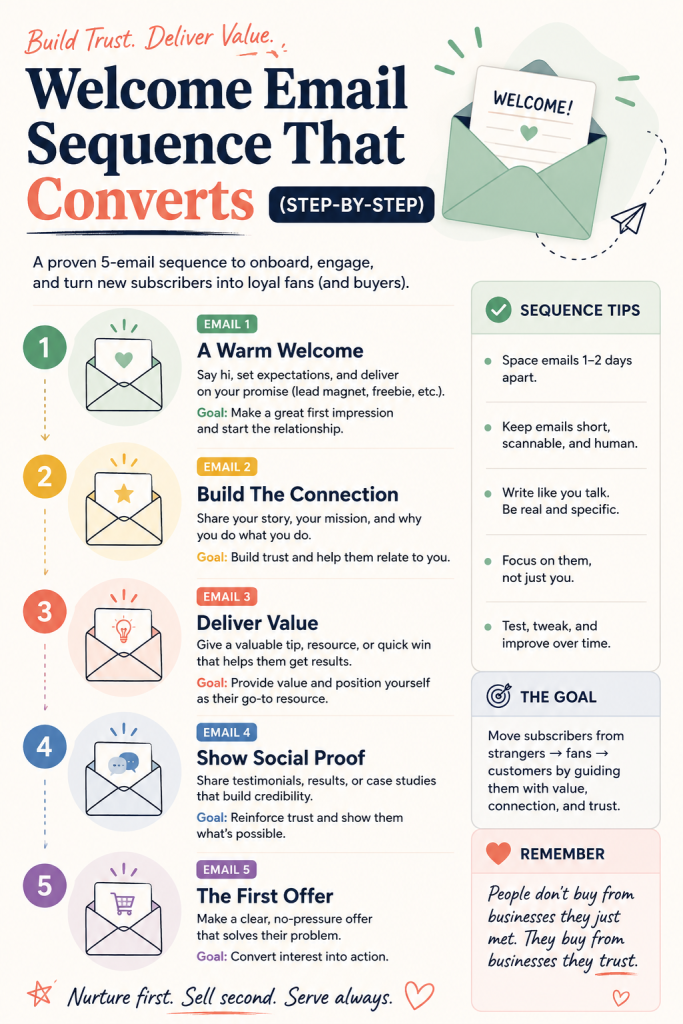
Welcome Email Sequence That Converts (Step-by-Step)
Welcome to another issue of From Inbox to Income — where we turn thoughtful emails into reliable revenue, share strategies that actually work, and help soulful solopreneurs sell without sounding like a late-night infomercial host. ✉️✨
Know someone who has a growing email list but treats new subscribers like awkward houseguests they forgot to greet? Forward this to them.
In today’s issue:
● Why most welcome emails quietly sabotage sales
● The 5-email sequence that builds trust and momentum
● The psychology shift that makes subscribers actually want to buy
Your Welcome Email Is Not a Formality. It’s a First Date.
Most solopreneurs treat welcome emails like the free bread basket at a restaurant.
Nice to have.
Expected.
Not the main event.
That’s a mistake.
Because your welcome sequence isn’t administrative housekeeping.
It’s positioning.
It’s emotional framing.
It’s the digital equivalent of someone walking into your boutique and you either:
A) warmly greeting them, showing them around, making them feel like they belong…
or
B) silently throwing a brochure at their face.
One gets loyalty.
The other gets unsubscribes.
And yet?
Most welcome emails sound like this:
“Thanks for subscribing! Here’s your freebie!”
End scene.
No personality.
No trust-building.
No momentum.
No reason to stay.
Let’s fix that.
The Real Job of a Welcome Sequence
Your welcome sequence has one job:
Turn curiosity into connection. Then turn connection into conversion.
That’s it.
Not “tell them every detail about your business.”
Not “dump twelve links and pray.”
Not “immediately pitch your $2,000 offer like a caffeinated street vendor.”
Your new subscriber is in a fragile emotional state.
They’re interested…
…but skeptical.
Hopeful…
…but cautious.
A little like adopting a rescue dog.
Too aggressive? They bolt.
Too passive? They forget you exist.
The goal is trust with movement.
The 5-Email Welcome Sequence That Actually Converts
Here’s the framework I recommend.
Simple. Human. Effective.
Email 1: The Warm Welcome
Goal: Deliver the promised thing + establish emotional tone
This email should answer one silent question:
“Did I make the right decision?”
Your job is to make the answer feel like a confident yes.
Include:
✅ Deliver the lead magnet/freebie
✅ Thank them like a human
✅ Briefly explain what they can expect
✅ Reinforce who this is for
Example:
You’re here because you want emails that connect and convert—without sounding like you borrowed your copy from a 2014 funnel bro.
See the difference?
That line does more than inform.
It positions.
Email 2: Your Story (But Make It Relevant)
Goal: Build trust through relatability
Nobody subscribes because they desperately want your autobiography.
They subscribe because they want a better version of their future.
Your story matters only if it helps them see themselves.
Framework:
I struggled with X → discovered Y → now help others do Z
Example:
“A few years ago, I thought good email marketing meant sounding polished and persuasive.
What it actually meant was sounding like myself—with strategy.”
That’s connection.
People trust people who’ve walked the path.
Email 3: The Quick Win
Goal: Create momentum through immediate value
This is where most creators underdeliver.
A subscriber should experience a useful result before you ever sell anything.
Not theory.
Not vague inspiration.
A win.
Examples:
- A subject line framework
- A welcome email template
- A segmentation trick
- A 10-minute inbox audit
Why?
Because confidence comes from movement.
And movement creates reciprocity.
Email 4: Shift Their Belief
Goal: Reframe the problem
This email is psychology.
Because many people don’t need more tactics.
They need a better lens.
For example:
Old belief:
“I need more subscribers.”
New belief:
“I need better subscriber relationships.”
Or:
Old belief:
“I’m bad at email.”
New belief:
“I’ve been using systems that don’t fit my voice.”
This email creates desire by changing identity.
That’s where conversions begin.
Email 5: The Invitation
Goal: Make the offer
Now—and only now—you sell.
Because now they know:
Who you are.
How you think.
What you help with.
Why your approach works.
Selling before trust is like proposing marriage during appetizers.
Technically possible.
Emotionally concerning.
Structure:
Problem → possibility → invitation
Example:
“If writing emails still feels harder than it should, I built something for you…”
Clean.
Low pressure.
Human.
Timing Matters More Than You Think
A strong sequence with terrible timing is like serving dessert before dinner.
Recommended cadence:
📅 Day 0 — Welcome
📅 Day 1 — Story
📅 Day 3 — Quick win
📅 Day 5 — Belief shift
📅 Day 7 — Offer
This works because momentum compounds.
Too slow?
They forget you.
Too fast?
You become digital wallpaper.
Common Welcome Sequence Mistakes
Let’s save you from inbox crimes.
❌ Selling immediately
Trust has not been built.
❌ Making it all about you
Nobody joined your list for your memoir.
❌ No clear next step
Confused readers don’t convert.
❌ Writing like a corporation
Unless your dream client is a procurement officer named Gary.
❌ No personality
People remember voices, not templates.
The Bigger Shift
Here’s what most marketers miss:
A welcome sequence is not automation.
It’s hospitality.
That distinction changes everything.
Automation says:
“How do I scale communication?”
Hospitality asks:
“How do I make someone feel expected, understood, and excited to be here?”
The second one sells better.
Every time.
Because people buy when they feel safe.
And they stay when they feel seen.
Closing Thought
Your first emails teach subscribers how to experience your brand.
Teach them well.
Because the inbox remembers first impressions.
Repeatable proverb:
“The best welcome sequences don’t chase the sale. They earn the conversation.”