
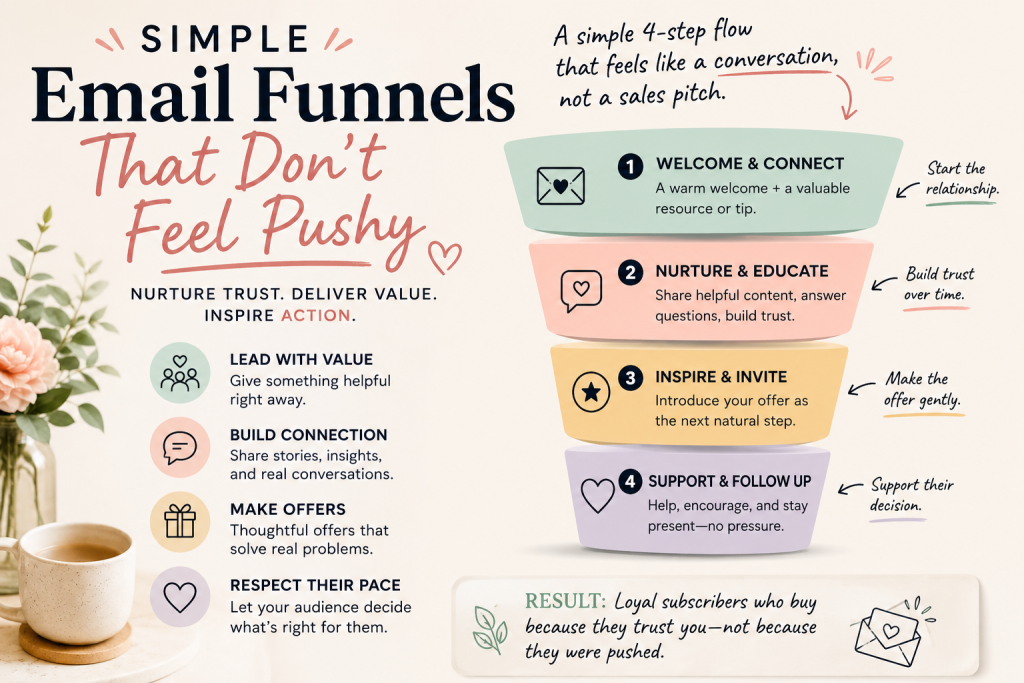
Simple Email Funnels That Don’t Feel Pushy
There’s a certain kind of exhaustion that comes from trying to “optimize” your audience into buying.
You know the feeling.
You open a marketing email and immediately feel like you’ve walked into a timeshare presentation disguised as empowerment.
Every sentence is pressing harder.
Every countdown timer feels louder.
Every CTA sounds like it drank three espressos and started quoting Wolf of Wall Street.
And somewhere in the middle of all that noise, thoughtful solopreneurs quietly wonder:
“Is there another way to sell through email… without sounding like I’m cornering someone at a networking event?”
Yes.
There is.
In fact, the highest-converting funnels I’ve seen lately aren’t the loudest.
They’re the clearest.
Because people don’t actually want to be pushed into buying.
They want to feel safe enough to decide.
That changes everything.
The Real Problem Isn’t Funnels
Funnels aren’t manipulative by default.
Bad emotional energy inside the funnel is what feels manipulative.
A simple funnel is just:
- A sequence of conversations
- Delivered at the right time
- With enough clarity to help someone move forward
That’s it.
But somewhere along the way, “email funnels” became associated with pressure tactics, fake urgency, and copy that sounds like it was written by a caffeinated chatbot wearing a blazer.
The result?
A lot of brilliant business owners avoid building funnels altogether.
Especially creative entrepreneurs.
Especially heart-centered coaches.
Especially people like Lena — the thoughtful solopreneur who wants her marketing to feel aligned, intelligent, and human.
So instead of creating systems, they rely on inconsistent posting, random newsletters, and “hoping people remember they exist.”
Which is kind of like opening a beautiful café… then never putting up a sign outside.
A Good Funnel Should Feel Like Guidance
Not persuasion theater.
Think of your funnel like hosting someone in your home.
You wouldn’t open the door and immediately yell:
“BUY THE COURSE BEFORE MIDNIGHT.”
You’d welcome them in.
Offer context.
Build trust.
Help them understand what’s possible.
That’s what a healthy funnel does.
It reduces confusion.
And confused people rarely buy.
The Simplest Funnel I Recommend Right Now
If your business feels overly complicated, start here.
You only need 3 parts:
1. A Warm Welcome Email
This is not the place to dump credentials like you’re applying for LinkedIn sainthood.
This email has one job:
Help the reader feel emotionally oriented.
Answer:
- Who are you?
- What do you believe?
- What kind of experience can they expect from your emails?
- Why should they stay subscribed?
A good welcome email feels like someone pulling out a chair for you at the table.
Not a pitch deck in disguise.
One of the simplest frameworks:
The “3-Part Welcome”
- What I believe
- What you can expect here
- What to do next
Clean.
Human.
Effective.
2. A Value Sequence That Solves Small Problems
This is where most funnels become accidentally aggressive.
People try to prove expertise by overwhelming subscribers with information density.
But trust is not built through volume.
It’s built through usefulness.
Solve one small problem per email.
Not seventeen.
For example:
- One email about writing stronger subject lines
- One email about creating a nurture rhythm
- One email about why most CTAs feel robotic
- One email about storytelling in launches
Tiny wins create momentum.
And momentum creates buyers.
You do not need to “convince” people when your emails repeatedly create clarity.
That clarity becomes the sales mechanism.
3. A Soft Invitation
This is the part many people overcomplicate.
A soft invitation is not weak.
It’s respectful.
Instead of:
“BUY NOW BEFORE THE WINDOW CLOSES FOREVER.”
Try:
- “If you want help implementing this, here’s the next step.”
- “If this resonated, you’d probably enjoy the full framework.”
- “If you’re tired of doing this alone, I made something for you.”
See the difference?
One approach corners people.
The other creates agency.
And agency builds trust.
Ironically, trust usually converts better long term than pressure ever does.
Why Gentle Funnels Often Perform Better
Because modern audiences are emotionally exhausted.
People are filtering thousands of messages a week.
They’ve developed aggressive “sales language radar.”
The second something feels emotionally coercive, they pull away.
But clarity?
Calmness?
Specificity?
Earned trust?
Those still cut through.
Especially in the solopreneur space.
Especially with audiences who value intelligence and authenticity over hype.
The future of email marketing isn’t louder funnels.
It’s safer ones.
Funnels that feel like:
- thoughtful guidance
- emotional clarity
- useful conversations
- momentum without manipulation
That’s the shift.
A Final Thought
You do not need to become a different person to build an effective email funnel.
You do not need fake urgency.
You do not need bro-marketing energy.
You do not need twelve timers and a PDF called “The Conversion Apocalypse.”
You need:
- clarity
- consistency
- emotional honesty
- and a system simple enough to sustain
Because sustainable email marketing is less about pressure…
…and more about becoming the person your audience trusts to help them make good decisions.
One calm email at a time.