
Email Opportunities That Actually Help You Connect and Get Results
Email opportunities are often approached as a way to reach people, to place an offer in front of an audience and hope it resonates. But reaching someone and connecting with them are not the same thing. Most emails are written to be seen, not to be understood. They move quickly, push a point, and disappear just as fast. And while they may generate moments of attention, they rarely create anything that lasts. Because connection doesn’t come from how often you show up. It comes from whether what you say holds meaning when someone reads it.
The emails that actually get results work differently. They don’t try to force action. They focus on making something clear enough that action becomes a natural response. They take the time to meet the reader where they are, to speak in a way that feels grounded rather than constructed, and to carry a message that doesn’t rely on pressure to be effective. When someone feels understood, when the message reflects something they’ve been trying to make sense of themselves, trust begins to form quietly. And it’s that trust that creates results—not in a single moment, but over time, as each email adds to something that continues to build rather than reset.
nvesting in your future doesn’t begin with expectation. It begins with a decision to engage with something in a way that allows it to take shape. Most people encounter an opportunity and pause at the idea of it, as if recognising it is enough to create change. But recognition doesn’t produce anything on its own. Value isn’t found in what you see—it’s created through what you do with it. And without that application, nothing shifts. The opportunity remains exactly where it started, untouched by the effort required to turn it into something real.
That’s where the return actually begins to form.
When you take the time to understand what you’re working with, not just at a surface level but in a way that connects it to your own situation, the process starts to change. When you follow through with consistent action, even when the results aren’t immediate, something begins to build beneath the surface. It doesn’t arrive all at once. It develops gradually, through repetition and refinement. What once felt like potential starts to take on weight. It becomes measurable, not because it was promised, but because it was applied.
Because once an opportunity is used, it stops being information.
It becomes part of how you operate.
And over time, that process creates something far more stable than expectation ever could. It produces results that aren’t dependent on chance or timing, but on the consistency of what you’ve built and the understanding you’ve developed along the way.
Email Marketing On Fire

Click Here For Access
Email Marketing On Fire
Unique & Genius 15-Minute Email Marketing Strategies For Extracting “Stupid” Amounts Of Money Even From The Tiniest Emails Lists! The Email On Fire System has one primary purpose: To give you unique and proven email marketing strategies to extract crazy amounts of money even from the tiniest email lists as well as to provide you with knowledge and tools to create a true lifestyle business… …So you could finally stop wasting time and money on countless methods and strategies that take forever to yield any results… And if any at all. If this claim seems a bit far-fetched, I want you to know that I don’t play games. I can honestly say that I take pride in my products because I know that they get people results… Plain and simple.
Lightning List

Click Here For Access
Lightning List
10 X Great List Building methods that work for any niche. No tech skills are needed. Newbie friendly. This is genuine ‘Gold Dust’ content you will love.
E-farming System

Click Here For Access
E-farming System
Copy what I do for the next 30 days to start your own highly-profitable e-Farming online business and start making money from anywhere in the world.
Igor Khiefets a 7 fiqure internet millionaire will take you by the hand and guide you step by step through his 30 day plan to take you from $0 to $1,000 in 30 days if you do exactly what he tells you to do at the right time.
How Email Opportunities Actually Help Your Business Grow
Email opportunities are often misunderstood because they appear too simple. A message sent, a list of subscribers, a link placed somewhere within the body. On the surface, it doesn’t seem like enough to create meaningful growth. And because of that, many people treat email as something secondary, something to use occasionally rather than something to build with intention. But what gets overlooked is not the simplicity of email—it’s the depth of what it allows when it’s used properly.
Because email isn’t just a way to communicate. It’s a way to build continuity.
Most platforms rely on moments. A post is seen, a video is watched, and then the interaction ends. The next piece of content has to begin again, as if nothing existed before it. But email works differently. It carries a thread. Each message doesn’t replace the last—it builds on it. And over time, that accumulation becomes something far more valuable than isolated attention.
This is where real growth begins.
Not from sending more emails, but from creating something that connects across them. A consistent message. A clear direction. A sense that what you’re sharing isn’t random, but part of something that’s developing over time. When that consistency is present, the relationship with your reader begins to change. You’re no longer someone appearing occasionally in their inbox. You become a familiar presence, something they recognise and return to.
And familiarity, when it’s built through clarity, becomes trust.
Trust isn’t created through a single message. It doesn’t come from a perfectly written email or a well-placed offer. It forms gradually, through repetition that feels aligned rather than forced. When someone reads your emails and finds that each one makes sense, that each one reflects the same underlying thinking, they begin to rely on that consistency. They stop questioning whether what you’re sharing is worth their attention, because it has already proven itself over time.
This is what most people miss when they focus only on immediate results. They measure success by opens, clicks, conversions—metrics that capture a moment but not the process behind it. And when those numbers don’t meet expectations, the response is often to change direction, to try something new, to adjust the approach again. But in doing that, the continuity is lost. The thread breaks. And without that thread, the relationship never has the chance to develop fully.
Email opportunities work when they are given time to compound.
Each message adds a layer. Not just of information, but of understanding. You begin to see what resonates, what needs to be explained more clearly, what can be simplified. And through that process, your communication becomes sharper, not because you’re trying to improve it directly, but because you’re learning how to express what matters in a way that can be received.

This is where alignment starts to take shape.
Because growth doesn’t come from saying more. It comes from saying what matters in a way that stays consistent. When your emails reflect something real—your perspective, your way of seeing things, your approach to solving problems—they begin to attract people who resonate with that way of thinking. And those are the people who stay. Not because they’re being persuaded, but because what you’re sharing continues to make sense to them.
This changes the role of your offers.
Instead of being the centre of each email, they become part of a larger context. Something that fits naturally within the conversation that’s already been built. When trust is present, an offer doesn’t need to be pushed. It doesn’t need to be framed as urgent or positioned as something that can’t be missed. It simply needs to be clear. Because the decision to engage with it has already been shaped by everything that came before.
This is why email opportunities don’t rely on constant promotion to create results. They rely on clarity that builds over time.
And that clarity doesn’t come from writing more complicated emails. It comes from simplifying what you’re trying to communicate. From removing what isn’t necessary. From focusing on the idea itself rather than how it’s being presented. When that happens, your emails begin to carry weight. Not because they are longer or more detailed, but because they are easier to understand.
Understanding is what creates movement.
When someone reads an email and can immediately see how it relates to their situation, how it connects to something they’ve been thinking about or trying to solve, they don’t need to be convinced. The next step becomes obvious. And when that happens repeatedly, across multiple emails, the process of taking action becomes natural rather than forced.
This is where growth becomes predictable.
Not in the sense that every email will produce the same result, but in the sense that the underlying system is working. You’re not starting from zero each time. You’re building on something that already exists. And that accumulation creates stability. It allows your business to grow without relying on constant bursts of attention or one-time efforts that need to be repeated again and again.
Over time, your email list becomes more than a collection of contacts. It becomes an asset. Not because of its size, but because of the relationship it represents. A group of people who understand what you do, who trust how you communicate, and who are open to what you offer because it fits within something they’ve already experienced.
That’s what makes email different.
It doesn’t require you to chase visibility. It allows you to build depth.
And depth is what sustains growth.
Because when your business is built on something that people understand and trust, it doesn’t depend on constant reinvention. It doesn’t need to rely on trends or external platforms to remain effective. It continues to work because the foundation it’s built on remains intact.
In the end, email opportunities are not about sending messages.
They’re about building something that connects over time.
Something that allows your ideas to develop, your communication to strengthen, and your business to grow in a way that doesn’t feel forced or uncertain.
And when that process is in place, growth stops being something you chase.
It becomes something you build.
Take Action Today
People who lose and achieve nothing in life do not make quick decisions NO they procrastinate and um and are and become locked in indecision because of their FEAR of losing. They concentrate on this and turn it into a reality and then they wonder why they don't succeed. Successful people make quick decisions and then change those decisions very slowly.
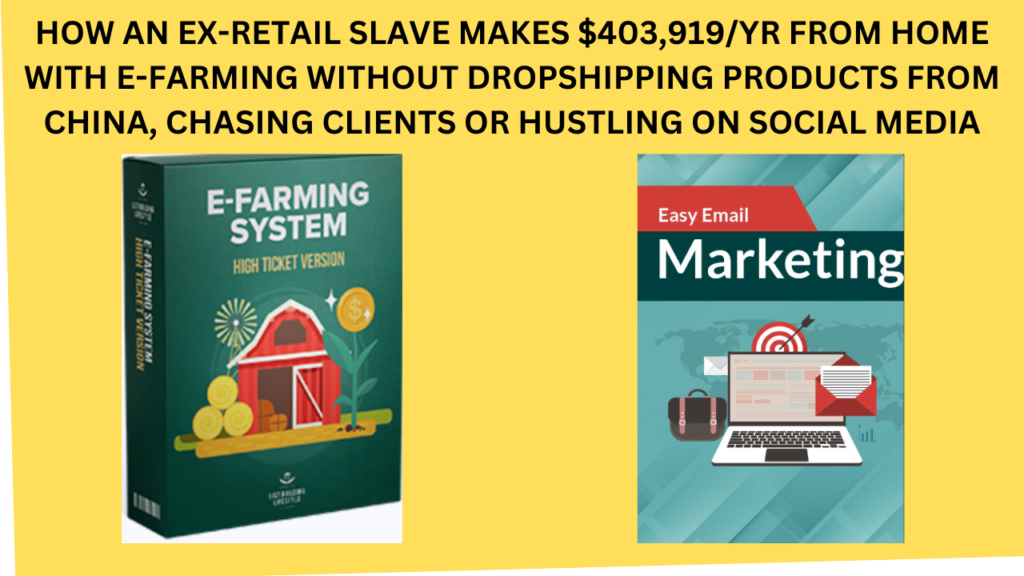
E-farming System High Ticket
Click Here For Access
E-farming System High Ticket Version
Copy what I do for the next 30 days to start your own highly-profitable e-Farming online business and start making money from anywhere in the world. The high ticket $997 version of Igor’s eFarming System.
The 301K Challenge

Click Here For Access
The 301K Challenge
Paint-by-numbers follow-along quick-start training for beginners. Get from 0 To $1,000 with affiliate marketing in just 30 days.
Igor Khiefets a 7 fiqure internet millionaire will take you by the hand and guide you step by step through his 30 day plan to take you from $0 to $1,000 in 30 days if you do exactly what he tells you to do at the right time.
The 301K Challenge Lead Magnet

Click Here For Access
The 301K Challenge Lead Magnet
The lead magnet version of Igor’s “Paint-by-numbers” follow-along quick-start training for beginners. Get from 0 To $1,000 with affiliate marketing in just 30 days.
Why Email Opportunities Actually Work, And Why People Respond to Them
Email opportunities work in a way that often goes unnoticed because they don’t rely on spectacle. They don’t interrupt, they don’t demand attention in the same way other platforms do, and they rarely create the kind of visible momentum people associate with growth. And because of that, they are easy to underestimate. It can feel like something quieter couldn’t possibly be as effective. But what makes email powerful isn’t what it looks like on the surface. It’s what it allows beneath it.
Because email doesn’t exist in moments. It exists in continuity.
When someone joins your list, they’re not stepping into a single piece of content. They’re stepping into an ongoing conversation. And that changes the nature of how communication works. You’re no longer trying to create impact in one interaction. You’re building understanding over time. Each message becomes part of something larger, something that doesn’t reset every time you send a new email, but instead builds on what already exists.
This is where most people misunderstand why email opportunities actually work. They assume the effectiveness comes from the offer itself. The product, the promotion, the way it’s presented. And while those things play a role, they are not what creates the response. The response comes from what has been built before the offer ever appears.
Because people don’t respond to offers in isolation. They respond to context.
They respond to whether the person presenting the opportunity feels consistent. Whether the message aligns with what they’ve seen before. Whether it makes sense within the understanding that has already been formed. And when that context is clear, the need for persuasion becomes far less important. The decision begins to feel natural, not because it’s being pushed, but because it fits.
This is why the same offer can perform differently depending on how it’s introduced. In one case, it feels disconnected, something placed in front of the reader without enough grounding. In another, it feels like a continuation, something that naturally follows from what has already been shared. The difference isn’t in the offer. It’s in the clarity surrounding it.
Clarity creates trust.
And trust is what allows someone to move forward without hesitation.
When a reader opens your emails and finds that each one makes sense, that each one reflects a consistent way of thinking, something begins to settle. They stop approaching your messages with uncertainty. They begin to expect that what they’re reading will be worth their attention. And over time, that expectation turns into something more stable. It becomes a form of reliability.
This is what most forms of content struggle to create. Because they rely on reach rather than relationship. They try to capture attention quickly, often without enough space to build understanding. And while that can generate visibility, it rarely creates the kind of connection that leads to sustained response.

Email works because it allows that connection to develop.
It gives space for ideas to be explained properly, for perspectives to be shared without being rushed, for meaning to form gradually rather than being forced into a single moment. And when someone has that space, they engage differently. They’re not just reacting. They’re considering.
This is where the response begins to take shape.
Not as an immediate reaction, but as a decision that has been building over time.
Because when someone reads your emails consistently, they’re not just absorbing information. They’re forming an understanding of how you think. They’re seeing how your ideas connect, how your perspective remains consistent across different topics, how your message holds together without needing to be constantly adjusted. And that consistency is what creates confidence.
Confidence doesn’t need to be pushed.
It develops naturally when something makes sense repeatedly.
This is why people respond to email opportunities even when the offer itself isn’t presented in an aggressive or highly persuasive way. They’re not responding to the language. They’re responding to the understanding that has already been built. The email simply gives them a way to act on something they already recognise.
And that recognition is what makes the response feel easy.
It removes the friction that often exists when someone is unsure. It eliminates the need to question whether something is right for them, because that question has already been answered through previous interactions. The email doesn’t need to create urgency. It simply needs to provide clarity.
This also changes how you approach writing over time.
Instead of trying to make each email perform, you begin to focus on making each email contribute. You’re not measuring success by immediate results, but by whether the message strengthens the overall understanding you’re building. And when that becomes the focus, the pressure to create something impactful every time begins to fade.
Because impact is no longer isolated.
It accumulates.
Each email adds to what has already been established. Each one reinforces the same underlying message, even when the topic shifts. And over time, that accumulation becomes something far more powerful than any single piece of content. It becomes a system that supports response consistently.
This is what makes email opportunities sustainable.
They don’t rely on constant reinvention. They don’t require you to chase new strategies or adjust your approach every time something changes. They work because they are built on something stable—clarity, consistency, and the ability to connect ideas over time.
And when those elements are in place, growth becomes less unpredictable.
Not because every email will perform the same, but because the foundation remains intact. You’re not starting from zero with each message. You’re building on something that continues to strengthen with each interaction.
In the end, email opportunities work not because they are persuasive, but because they are cumulative.
They allow you to build something that people can understand, trust, and return to. They create a space where decisions are made through clarity rather than pressure. And they give you a way to grow your business through connection instead of constant visibility.
That’s why people respond to them.
Not because they are being convinced in a single moment, but because they have already reached a point where the next step makes sense.
Elite Affiliate Pro

Elite Affiliate Pro
Follow the marketing plan that made Igor the #1 affiliate for John Crestani, Anthony Morrison, Michael Cheney, Matt Bacak and many other gurus.
Elite Traffic Pro 2.0

Click Here For Access
Elite Traffic Pro 2.0
This exclusive “Over The Shoulder” training has been designed to help students get more traffic, more money, and most importantly – more freedom!
MADS Academy

Click Here For Access
MADS Academy
A step-by-step guide to putting your affiliate marketing business on steroids with Microsoft Ads; a little-known traffic source that’s producing $4,017.88 paydays (without creating content, networking on social media, or running expensive & confusing Facebook ads).
How Email Video Opportunities Actually Work (And How to Use Them)
Email video opportunities are often approached with the same mindset people bring to any new tactic. Add something different, expect a better result. A video inside an email feels like an upgrade, something more engaging than plain text, something that should naturally increase clicks and conversions. And sometimes it does. But when it doesn’t, the confusion sets in. Because the assumption was that the format itself would create the outcome.
It doesn’t.
A video doesn’t change the result on its own. It only changes how the message is experienced. And if the message isn’t clear to begin with, the video simply carries that same lack of clarity in a different form. It may hold attention slightly longer, it may create a sense of variation, but it won’t fix what isn’t working underneath. Because what drives response in email isn’t the format. It’s the understanding that the format delivers.
This is where email video opportunities actually begin to make sense. Not as a replacement for written communication, but as a way to deepen it. A way to make something easier to grasp, easier to feel, easier to trust. Because there are moments when words alone can explain an idea, but not fully carry it. And in those moments, video becomes useful—not because it is more impressive, but because it allows the message to land more clearly.
But that only happens when the video has a defined role.
Most people add video to email without deciding what it’s meant to do. It becomes an extra element, something included because it seems like a good idea. And without a clear role, it struggles to contribute. It doesn’t guide the reader. It doesn’t resolve anything. It simply sits alongside the message instead of supporting it.
When video is used properly in email, it removes friction.
It takes something that might feel abstract in text and makes it visible. It allows the reader to see how something works, to hear the tone behind the message, to understand the intention without needing to interpret every word. And in doing that, it shortens the distance between curiosity and clarity.
This is especially important when the opportunity you’re presenting involves something that needs to be experienced rather than just described. A system, a process, a way of working—these are things that often become clearer when they are shown. Not in a polished or overly structured way, but in a way that feels real enough to trust.
Trust is where video makes its strongest contribution.
Because while written words can explain, video can confirm. It shows that what is being said holds up when it’s expressed directly. It removes some of the distance that naturally exists in text. And when that distance is reduced, the message begins to feel more grounded.
But again, this only works when the video is aligned with the message itself.
If the email is unclear, the video will be unclear. If the message is scattered, the video will feel the same. The format amplifies what is already there. It doesn’t replace the need for clarity—it depends on it.
This is why the way you use video in email matters more than the fact that you’re using it at all.
Some videos are meant to explain. To take an idea that might feel complex and break it down in a way that feels easier to follow. These don’t need to be long or detailed. They need to be focused. They need to stay close to the point, removing anything that doesn’t contribute to understanding.
Other videos are meant to reassure. To address the questions that often go unspoken. What does this actually look like? What should I expect? Is this something I can realistically apply? These are the moments where hesitation lives, and when they are handled clearly, they don’t need to be pushed aside. They dissolve naturally.
And then there are videos that simply connect. Not explaining or demonstrating, but allowing the reader to experience the tone behind the message. To see the person behind the words, to understand how they think, to feel whether the message resonates beyond its structure. These are often the simplest videos, but they carry a different kind of weight. Because connection doesn’t come from information alone. It comes from recognition.
When these roles are understood, email video opportunities stop feeling like an experiment and start becoming part of a system.
Each video has a place. Each one supports the message instead of competing with it. And over time, this creates a different kind of consistency. Not just in what you say, but in how you communicate it.
This consistency is what allows trust to build at a deeper level.
Because when someone receives your emails and finds that both the written and visual elements align, that they carry the same clarity, the same tone, the same intention, something begins to settle. They’re not adjusting to a new style each time. They’re engaging with something familiar, something that holds together.
And that familiarity reduces resistance.
It makes it easier for someone to stay with your message, to follow it without needing to question it at every step. And when that happens, the role of your emails changes. They stop being individual attempts to create action, and start becoming part of an ongoing process that supports it.
This is where results begin to stabilise.
Not because every email performs the same, but because the foundation behind them is consistent. The message is clear. The structure is defined. The use of video is intentional rather than reactive. And because of that, each piece contributes to something that continues to build.
In the end, email video opportunities work for the same reason email itself works.
They create continuity.
They allow understanding to develop over time, across different forms, without losing clarity. They give you a way to express ideas more fully, to reduce uncertainty, to build trust in a way that doesn’t rely on pressure.
But only when they are used with intention.
Because adding video is easy.
Using it in a way that actually supports your message—that’s where the difference is made.
And when that difference is in place, the results don’t feel forced.
They feel like a natural extension of something that already makes sense.