
You Don’t Need More Traffic, You Need Better Video
You don’t need more traffic in the way most people think you do. More views, more clicks, more eyes passing over what you’ve created—none of it guarantees movement if what they land on doesn’t hold their attention or lead them somewhere clear. Because traffic only amplifies what is already there. If the message is unclear, more traffic only spreads that confusion further. If the connection is weak, more traffic only creates more people who leave without taking action. What actually changes the outcome is not how many people arrive, but what they experience when they do.
This is where better video begins to matter. Not better in terms of production or complexity, but better in how it communicates. A video that understands the viewer’s position, that speaks directly to what they are trying to figure out, and that guides them through it with clarity creates a different kind of engagement. It holds attention because it feels relevant. It builds trust because it feels grounded. And it leads to action because it shows a path forward instead of just presenting information. When your video does that, traffic stops being the problem. Because the people who arrive are no longer just passing through—they are staying, understanding, and moving forward with you.
Building something online that actually lasts requires more than effort on its own. Effort can start movement, but it cannot sustain it without support. What creates stability is the way that effort is guided—through the right tools, used with intention, and applied at the right time. Without that, it is easy to fall into a pattern of scattered actions and inconsistent approaches, where progress feels temporary and difficult to maintain. Because when there is no structure beneath what you are doing, nothing has a place to hold, and everything begins to feel like it needs to be rebuilt again and again.
This is where a shift begins to take shape. You start to recognize that growth is not just about doing more, but about building in a way that can continue. The tools you choose become part of that process, not as surface-level additions, but as elements that support how your business functions. Tools that help you communicate with clarity, organize what you create, and turn your effort into something that follows a clear direction. Because when your work is supported in this way, it becomes easier to return to, easier to refine, and easier to build upon over time.
As that structure develops, something important begins to change. Progress no longer feels uncertain or dependent on isolated bursts of effort. It becomes something more steady, something that grows through continuation rather than repetition of the same starting point. And in that steadiness, you begin to see how each part of what you are doing connects. Ideas, systems, and tools begin to work together, not as separate pieces, but as part of a process that supports the outcome you are moving toward.
Over time, this becomes essential—not just for creating results in the moment, but for sustaining them. Because a business that lasts is not built on random actions or short-term momentum. It is built on something that can hold, something that can adapt, and something that can continue even when conditions change. And when that foundation is in place, growth begins to feel different. Not unpredictable or fragile, but structured, clear, and guided in a way that allows you to move forward with confidence, knowing that what you are building is not temporary, but something you can rely on.
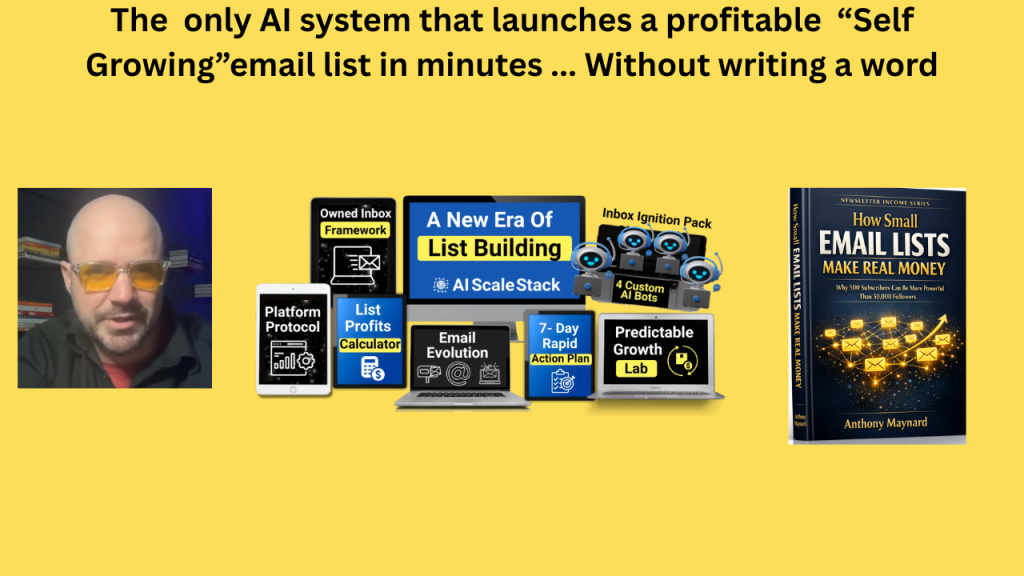
AI Scale Stack
Click Here For Access
AI Scale Stack
Stay Ahead of the Curve with AI-Driven Systems That Let You “Set It and Forget It”
AI has changed everything.
And if you’re paying attention, you already know that right now (more than any time in the last decade) regular people have the chance to build something that actually works.
But here’s what most people don’t know yet…
AI has made it easier than ever to build a reliable business, powered by an email list that grows itself…and be managed in under 30 minutes per day.
This isn’t theory. It’s not hype.
It’s the exact system we used to generate $94,113 in just 11 weeks … while building it live, from scratch, in front of a small test group.
For more than a decade, leading marketers and industry experts have paid us millions to carefully develop and install this exact same reliable system into their business.
And today, thanks to recent advancements in AI technology…
We’re making this previously exclusive email marketing solution accessible to anyone who’s tired of chasing funnels, buying endless courses, and inconsistent results.
Click Here For Access
The Invincible Marketer Program
A step-by-step guide to putting your affiliate marketing business on steroids with Microsoft Ads; a little-known traffic source that’s producing $4,017.88 paydays (without creating content, networking on social media, or running expensive & confusing Facebook ads).
Proto = Storeless Ecom
Click Here For Access
Proto
World’s First App That Let Us Crush eCom WITHOUT Creating A Store…
“Launch Your Own eCom Super Funnels With WINNING Products In 60 Seconds WITHOUT Creating A Single Store or Shopify”
Proto Is The World’s First App That Builds “eCom Super-Funnels” That Converts 10x Better Than The Regular Stores/Shopify/Amazon & Generates $1000 – $3000 Daily
It Also Comes Loaded With Hundreds Of HOT Trending Products, Supplier’s Link, Price Markups, Facebook Creativity, Videos, Targeting & Every Other Tool You Need To Crush eCom.
How to Create Ecommerce Videos That Earn the Sale Before the Click
Most ecommerce videos don’t fail because of poor lighting, bad editing, or a lack of creativity. They fail much earlier than that—at the level most people never think to examine. They fail in the quiet space between attention and belief. Because a view is not a signal of intent. A play button clicked is not a hand raised. And a beautifully shot product, rotating slowly against a clean background, does not answer the one question every buyer is silently asking: Why should I trust this enough to choose it?
This is the gap most brands fall into. They assume the job of video is to showcase. To present. To impress. But the videos that earn the sale before the click do something far more subtle. They reduce uncertainty. They anticipate hesitation before it fully forms. They meet the viewer not as a passive observer, but as someone standing at the edge of a decision, weighing risk against desire. And in that moment, the role of your video shifts—from display to reassurance.
The first principle is simple, but rarely followed: clarity over cleverness. A viewer does not arrive at your product page hoping to decode your creativity. They arrive hoping to understand, quickly and intuitively, whether this product fits into their life. The most effective ecommerce videos remove friction by showing the product in context, in motion, in use. Not as an abstract object, but as a solution already working. A jacket being worn on a windy street. A kitchen tool slicing cleanly through something that used to be difficult. A skincare product applied in real light, on real skin, without the disguise of perfection. These are not just demonstrations. They are answers.
But clarity alone is not enough. Because people do not buy based on understanding. They buy when understanding is paired with resonance. When they can see themselves inside the outcome. This is where most videos stop too early. They explain what the product does, but they never cross into what it feels like to own it. And that emotional distance, however small, is often the reason a customer hesitates, opens another tab, or decides to “think about it later.”
To close that distance, your video must carry a sense of lived experience. Not scripted enthusiasm, but quiet confidence. The kind that comes from showing, rather than telling. A moment of use that feels unforced. A detail that reveals care in the design. A small friction removed in a way that feels almost relieving to watch. These micro-moments build something far more powerful than persuasion. They build trust. And trust, in ecommerce, is the currency that converts.

There is also a pacing to videos that sell, and it is often slower than expected. Not in duration, but in intention. They do not rush to impress. They do not overload the viewer with features. Instead, they guide attention deliberately. One idea at a time. One benefit, fully seen. One moment of clarity, allowed to land before moving on. This rhythm mirrors how people actually make decisions—not in bursts of information, but in quiet confirmations. Yes, this makes sense. Yes, this feels right. Yes, I can see myself using this.
Another overlooked element is specificity. General claims—“high quality,” “easy to use,” “best in class”—fade quickly because they ask the viewer to do the interpretive work. Specificity removes that burden. It shows exactly what “easy” looks like. It reveals what “high quality” feels like in the hand, in the finish, in the small details most brands ignore. The more precise your video becomes, the less effort your customer has to expend imagining the result. And the less they have to imagine, the closer they are to deciding.
It’s also worth understanding that not every video needs to do everything. In fact, the most effective ecommerce experiences are built from a sequence of videos, each carrying a distinct role. One captures attention with a clear, immediate use case. Another deepens trust through demonstration. A third answers objections before they are spoken—durability, fit, ease of use, real-world performance. When these pieces work together, they create a layered experience that feels complete. Not overwhelming, but thorough. Not pushy, but prepared.
What ties all of this together is intention. The understanding that your video is not content for the sake of content. It is a bridge. A carefully constructed path from curiosity to confidence. And every frame, every cut, every moment included or excluded either strengthens that bridge or weakens it.
In the end, the goal is not to make a video that goes viral. Virality is a different game, with different incentives. The goal here is quieter, but far more valuable. To create something that, when watched by the right person at the right moment, feels like clarity. Like the answer they were already looking for, just articulated more precisely than they could have done themselves.
Because when a video does that—when it removes doubt, builds trust, and allows the viewer to see themselves on the other side of the purchase—the sale is no longer something that needs to be pushed. It has already, in many ways, been made. The click simply becomes the final, natural step.
Take Action Today
Do You realize that your qualification that may get you a job is just a starting point and that's all? Don't make the mistake of sitting on your job for forty years while hoping you will get success because the truth is you may not ever get what you are looking for. You have to step out and build your own boat and set your own sail if you want true success. Make a decision not to be a failure in life by grabbing the opportunity with both hands and then TAKE MASSIVE ACTION. Diehard4education will help you to succeed if you remain positive in the way you think.
Ecommerce Resources That Actually Help You Build and Grow
There’s a moment most ecommerce founders hit—usually late at night, somewhere between another abandoned cart notification and a half-finished product page—when the solution feels obvious: we just need better tools. A new app for conversions. A smarter analytics dashboard. A more advanced email platform. Something that promises clarity, speed, or scale. And for a moment, installing it feels like progress. Like momentum has returned.
But what often follows is quieter. The tabs multiply. The integrations stack. The workflows become more complex than the problem they were meant to solve. And somewhere in the middle of all that added capability, something essential gets lost: direction. Because tools, by design, expand what’s possible. But they don’t decide what matters.
This is the hidden cost of the modern ecommerce stack. Not the subscription fees, though those add up. Not even the time spent learning new systems. It’s the subtle shift from building a business to managing a collection of capabilities. From asking “what does my customer need to feel confident buying this?” to asking “which tool should I use next?” And those are not the same question. Not even close.
The businesses that grow steadily—the ones that feel calm beneath the surface—tend to operate differently. They are not anti-tool. They are simply intentional. They understand that a resource is not defined by what it can do, but by what it allows you to do better. Faster isn’t always better. More automated isn’t always more effective. And more features rarely lead to more clarity.
The distinction between tools and resources is subtle, but it changes everything. A tool is something you use. A resource is something that supports a specific outcome. It has a role. A boundary. A reason to exist within your ecosystem. And when you begin to think this way, your stack starts to simplify—not because you’re removing capability, but because you’re aligning it.
Take something as common as email marketing. There are dozens of platforms, each promising deeper segmentation, smarter automation, more control. But the platform itself is rarely the constraint. The real question is simpler, and harder: do you know what you want your emails to do? Are they meant to nurture trust, recover lost interest, guide a first-time buyer toward a confident decision? Without that clarity, even the most advanced system becomes noise. With it, a simpler tool becomes more than enough.
This pattern repeats across every layer of ecommerce. Analytics tools that generate reports no one acts on. Heatmaps that reveal behavior but don’t lead to changes. Review apps that collect feedback but never translate it into clearer messaging. Individually, each tool works. Collectively, they often create distance between you and the decisions that actually move the business forward.
The right resources, on the other hand, tend to feel almost invisible. They integrate cleanly into your thinking. They reduce friction instead of adding options. They make the next step obvious. A simple dashboard that highlights only the metrics that matter. A content library that shows your product in real use, ready to be deployed across pages and campaigns. A lightweight system for capturing customer questions and turning them into clearer product descriptions. These are not impressive on the surface. But they are effective where it counts.
There is also a psychological shift that happens when you move from accumulation to alignment. You stop chasing the feeling of being “set up correctly” and start focusing on being useful. You measure progress not by how sophisticated your stack looks, but by how easily a customer can move from curiosity to confidence. And that shift, while subtle, has a compounding effect on everything else.
It also forces a more honest evaluation of what’s actually working. Not in theory, but in practice. Which resources are actively contributing to sales, clarity, or customer experience? Which ones are simply there because they once felt necessary? Letting go of a tool is rarely about cost. It’s about removing friction—cognitive, operational, and sometimes emotional. Because every additional system asks for attention. And attention, in a growing business, is one of the few things you cannot scale.
None of this is an argument for minimalism for its own sake. Complexity has its place, especially as a business grows. But complexity should be earned. It should follow clarity, not attempt to replace it. The right ecommerce resources evolve alongside your understanding of your customer, your product, and your process. They are chosen deliberately, not reactively.
If there is a practical way to approach this, it begins with a single question: what is the next meaningful constraint in your business? Not the most interesting problem. Not the most visible one. The one that, if solved, would make everything else slightly easier. Then, and only then, do you look for a resource that addresses that constraint directly. Not five tools that might help. One resource that fits.
Over time, this approach builds something that feels different from the typical ecommerce operation. It feels lighter. More focused. Decisions happen faster because there is less noise around them. Execution improves because the path is clearer. And perhaps most importantly, the business begins to feel coherent—not as a collection of tactics, but as a system designed around a specific kind of customer experience.
Because in the end, your customer does not see your tools. They don’t know how many platforms you’ve integrated, how advanced your automation is, or how detailed your dashboards have become. They experience something much simpler. A page that either makes sense or doesn’t. A product that either feels trustworthy or doesn’t. A journey that either leads them forward or leaves them uncertain.
The right resources make that journey feel effortless. Not because they do more, but because they remove what doesn’t matter. And in ecommerce, where every small hesitation can become a lost sale, that kind of clarity is not just helpful. It’s decisive.

PRINTFUL - Print-On-Demand Store
PrintFul is an e-commerce platform that gives average people who haven’t got a lot of money to get a chance to start an eCommerce business to create and sell custom products online. Turn your ideas into premium products that leave a lasting impression

eBay - Design + instalation Store Website
Complete Professional Bespoke eBay Store Shop Design and Installation + Pages. Have your store professionally done so it has immediate credibility and makes a good impression on your future clients to trust you with their purchases.
Video Marketing Isn’t About More Views, It’s About What Happens After
here is a number that quietly distorts how most businesses think about video. It’s the view count. Clean, visible, endlessly refreshing. It gives the illusion of traction, of reach, of something working. And for a moment, it feels like progress. The video is being seen. People are watching. The algorithm, at least for now, is cooperating.
But a view is a fragile signal. It tells you someone paused. That’s all. It doesn’t tell you what they understood, what they felt, or whether anything in that brief interaction moved them closer to trusting you. And in the space between being seen and being believed, most video marketing loses its power.
This is where the real work begins—after the view. Not in the editing timeline or the filming setup, but in the outcome the video quietly shapes. Because the videos that grow a business are not the ones that travel the farthest. They are the ones that stay with the right person just long enough to change how they see something. A product. A problem. A possibility.
The shift is subtle, but it changes everything. Instead of asking, “How do we get more eyes on this?” the question becomes, “What happens in the mind of the person who watches this?” Do they feel clearer? More certain? Less skeptical? Can they picture themselves using what you offer without needing to fill in the gaps on their own? These are not metrics you’ll find in a dashboard, but they are the ones that determine whether a view becomes momentum or disappears without consequence.
Most video content is built for attention, not for continuation. It’s designed to stop the scroll, to entertain, to create a moment of interest. And there is value in that. But interest without direction is where growth stalls. Because once the video ends, the viewer is left with a quiet decision: do I move closer, or do I move on?
The videos that lead to growth answer that question before it’s even asked. They carry a sense of next step within them. Not always explicitly, not always with a call to action, but with a kind of internal logic that makes the path forward feel obvious. A product demonstration that removes doubt. A behind-the-scenes moment that builds credibility. A simple explanation that reframes a problem in a way that makes your solution feel inevitable. These are not loud moves. They are precise ones.
There is also an honesty required here that many brands avoid. Growth-driven video is not about showing the best version of your product in isolation. It’s about showing the truest version of the experience. How it fits into a real routine. What it replaces. What it simplifies. Where it might not be perfect, but is still better than the alternative. Because trust is not built through perfection. It is built through alignment—when what you show matches what someone will actually experience.

This is why some of the most effective videos feel almost understated. They are not trying to impress. They are trying to clarify. They don’t rely on fast cuts or trending sounds to hold attention. They rely on relevance. On speaking directly to a moment the viewer recognizes in their own life. And when that recognition happens, attention becomes something deeper. It becomes consideration.
Another layer, often overlooked, is consistency of message across touchpoints. A single video rarely carries the full weight of conversion. But it can set the tone. It can introduce an idea that is reinforced elsewhere—on the product page, in an email, in a follow-up piece of content. When these elements align, the viewer does not feel like they are being persuaded. They feel like they are arriving at a conclusion that has been quietly supported from multiple angles.
This is where video becomes less of a standalone tactic and more of a connective thread. It links awareness to understanding, understanding to trust, and trust to action. And when done well, it reduces the need for friction-heavy selling later. Because the heavy lifting has already been done in the moments after the view.
It’s also worth recognizing that not all views are equal. A thousand passive views rarely equal one engaged one. The person who watches with intent—who leans in, who replays a moment, who shares it with someone else—is already further along than the metrics suggest. And yet, most strategies are optimized for volume, not depth. For reach, not resonance.
Reorienting around what happens after the view means designing for that depth. It means accepting that fewer, more aligned viewers are more valuable than broad, indifferent reach. It means creating videos that might not perform the best in an algorithmic sense, but perform exceptionally well in a business sense. Because they lead somewhere. Because they convert.
In practical terms, this often looks like slowing down. Being more deliberate with what each video is meant to do. Not trying to say everything at once, but saying the right thing at the right moment. It means understanding where your viewer is in their decision process and meeting them there—whether they are discovering you for the first time or standing on the edge of a purchase.
And perhaps most importantly, it means redefining success. Not as views, but as movement. Did this video make the next step easier? Did it reduce hesitation? Did it answer a question the viewer didn’t yet know how to ask? These are quieter outcomes, but they compound. Over time, they build a system where each piece of content supports the next, where growth is not dependent on spikes of attention but on a steady accumulation of trust.
Because in the end, attention is only the beginning. It is the door, not the destination. And what you choose to do after that door opens—what you choose to show, to say, to clarify—determines whether your video becomes just another moment in someone’s feed, or the start of something that actually grows your business.

Sells For $69.00 - No Cost Today