
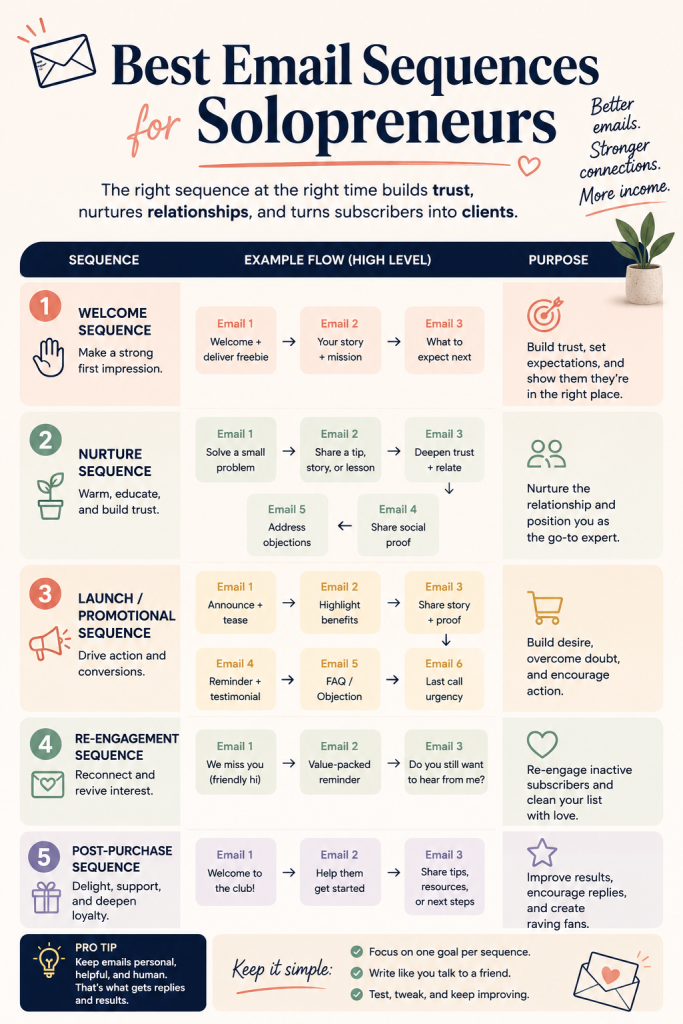
Best Email Sequences for Solopreneurs
Welcome to another issue of From Inbox to Income—where we turn thoughtful emails into sustainable revenue, share smarter strategies (without the sleaze), and support solopreneurs building businesses with both heart and margins. ☕✨
Know someone currently “just meaning to set up their email automations” for the 14th month in a row? Forward this to them.
In today’s issue:
● The 5 email sequences that quietly make solopreneurs more money
● Why newsletters alone are like bringing a butter knife to a strategy meeting
● The automation setup that saves your future self from chaos
Best Email Sequences for Solopreneurs (If You’d Like Revenue to Happen While You Sleep Like a Civilized Person)
Let’s begin with a gentle truth:
Most solopreneurs are trying to build recurring revenue with the email equivalent of sticky notes and hope.
A weekly newsletter here.
A launch email there.
A random “Hey, just checking in!” sent during a caffeine surge.
And look—I respect improvisation. Jazz exists for a reason.
But if your business depends entirely on you manually remembering what to send, when to send it, and why you opened ConvertKit in the first place…
That’s not a system.
That’s performance art.
The good news?
You do not need a labyrinthine 87-email funnel designed by someone who refers to themselves as a “growth ninja.”
You need a few intentional email sequences that work like trusted employees.
Quiet. Reliable. Never asking for PTO.
Here are the ones worth building.
1. The Welcome Sequence (Your Digital Handshake)
If someone joins your list and hears… nothing?
That’s awkward.
Imagine walking into someone’s beautifully designed dinner party and the host just stares at you from across the room.
That’s what no welcome sequence feels like.
A welcome sequence does three jobs:
1. Builds trust
2. Sets expectations
3. Moves subscribers toward a next step
A simple 4–5 email version works beautifully:
Email 1: The Warm Welcome
Deliver the freebie (if promised), say hello, explain what they can expect.
Email 2: Your Story
Why this business exists. What you believe. Why they should care.
People buy frameworks.
But they trust people.
Email 3: Quick Win
Give them something immediately useful.
Not fluff.
Not “mindset.”
An actual result.
Example:
“3 subject line frameworks that boost opens without sounding like a used car ad.”
Email 4: Common Mistakes
Help them avoid pain.
People move faster away from pain than toward possibility.
Human psychology is delightfully inconvenient that way.
Email 5: Soft Offer
Invite them to your service, product, consult, or next step.
Not a shove.
An invitation.
2. The Nurture Sequence (Because Trust Isn’t Built in One Weekend)
Too many solopreneurs treat email like speed dating.
“Hi.”
“Here’s my offer.”
“Why aren’t you ready?”
Slow down, Casanova.
A nurture sequence keeps your audience warm between launches and sales moments.
Think of it as relationship compound interest.
Good nurture emails include:
- Stories with lessons
- Tactical tips
- Behind-the-scenes thinking
- Client insights
- Myth-busting
- Personal observations with strategic takeaways
A simple nurture rhythm might look like:
Week 1: Teaching email
Week 2: Personal story
Week 3: FAQ / objection handling
Week 4: Light CTA
This sequence answers the question:
“Why should I keep opening your emails?”
Which, frankly, is the whole game.
3. The Sales Sequence (Without Becoming Weird About It)
Selling is where otherwise lovely business owners suddenly become unrecognizable.
Their tone shifts.
Urgency appears.
Random caps lock emerges.
It’s like possession, but with countdown timers.
A good sales sequence feels coherent—not desperate.
A simple structure:
Email 1: The Opportunity
Introduce the offer and the transformation.
What changes?
What becomes easier?
What problem gets solved?
Email 2: The Problem Agitation
Name what happens if nothing changes.
Respectfully.
No emotional hostage situations.
Email 3: Objection Crusher
Address common hesitations:
- “I don’t have time.”
- “Will this work for my business?”
- “I’ve tried something similar.”
Email 4: Social Proof
Stories. Testimonials. Results.
Borrowed certainty works.
Email 5: Final Call
Clear deadline.
Clear CTA.
No interpretive dance.
Sales emails don’t need aggression.
They need clarity.
4. The Re-Engagement Sequence (For Ghost Subscribers)
Some subscribers vanish.
No opens. No clicks. No signs of life.
Your list starts feeling like an abandoned mall.
Before deleting them, try a re-engagement sequence.
Why?
Because sometimes people are busy.
Or overwhelmed.
Or subscribed while standing in line for tacos.
A 3-email flow works:
Email 1: “Still interested?”
Simple. Honest.
Email 2: Value Bomb
Give something genuinely useful.
A reminder of why they joined.
Email 3: Breakup Email
Playful opt-out.
Example:
“I hate clingy relationships, so unless I hear otherwise, I’ll assume you’d like some inbox space back.”
This keeps your list healthier and improves engagement metrics.
Also: fewer ghosts.
5. The Post-Purchase Sequence (The Most Neglected Goldmine)
Here’s the tragedy:
A solopreneur works hard to make the sale…
…and then disappears.
That’s like proposing marriage and immediately moving to another country.
Post-purchase emails matter because they:
- reduce buyer’s remorse
- improve customer experience
- create referrals
- increase repeat sales
Suggested flow:
Email 1: Welcome / onboarding
“Here’s what happens next.”
Email 2: Implementation support
Help them actually use what they bought.
Revolutionary concept.
Email 3: Encouragement / mindset support
Momentum matters.
Email 4: Social proof invitation
Ask for feedback or testimonials.
Email 5: Ascension offer
If appropriate, invite the next step.
A happy customer is your cheapest future sale.
If You Build Only One Thing This Quarter…
Start with:
✅ Welcome Sequence
✅ Nurture Sequence
✅ Sales Sequence
That trio alone creates remarkable stability.
Because here’s the deeper truth:
Solopreneurs don’t usually struggle because they lack ideas.
They struggle because everything depends on remembering.
Email sequences remove memory from the revenue equation.
That’s freedom.
Not passive income fantasy freedom.
Real freedom.
The kind where your business still moves when you take Tuesday afternoon off and go touch grass.
Or drink espresso dramatically while pretending to “strategize.”
Both valid.
Final Thought
Your inbox is not a billboard.
It’s a conversation.
The solopreneurs who win long-term aren’t necessarily louder.
They’re simply more intentional.
Build systems that sound human.
That’s where the magic lives.