
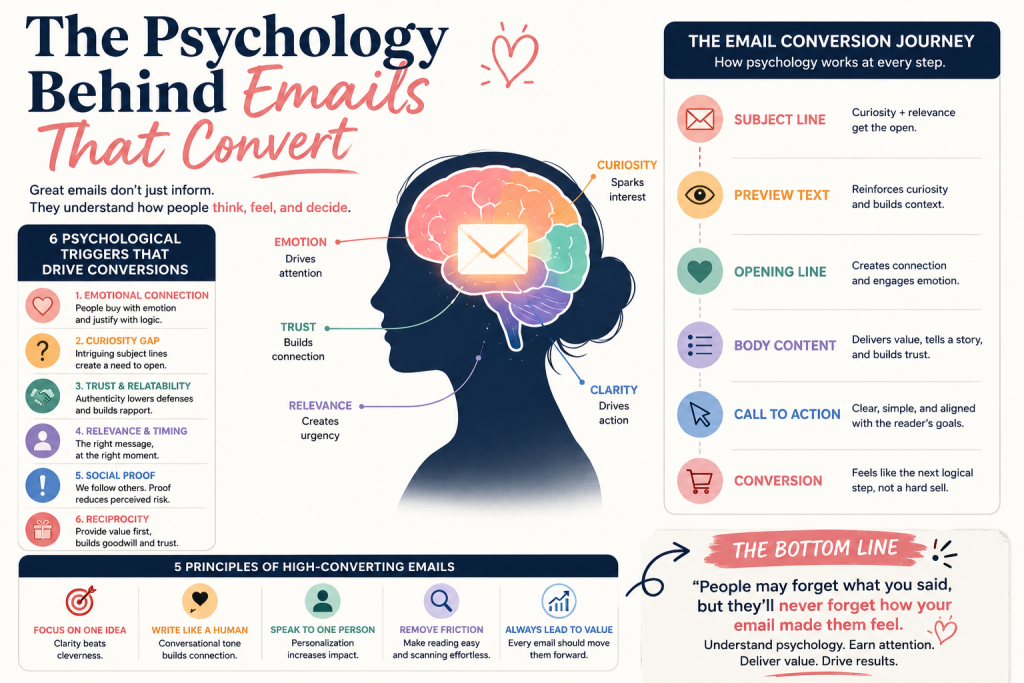
The Psychology Behind Emails That Convert
Why some emails feel irresistible—and others get ghosted faster than a bad Tinder date.
Let me tell you something mildly uncomfortable:
Most low-converting emails don’t fail because of bad copy.
They fail because they misunderstand human behavior.
That’s the part most email advice skips.
You’ll hear:
“Use urgency.”
“Write better subject lines.”
“Add more CTAs.”
“Use scarcity.”
Which is adorable.
That’s like handing someone a chef’s knife and saying, “Congrats, now you’re a Michelin chef.”
Tools are not psychology.
And email—the kind that actually converts—is less about persuasion tactics…
…and more about understanding what makes humans move.
Because no one buys because your bullet points were beautifully aligned.
People buy because something emotional clicked.
Let’s talk about what actually causes that click.
1. Familiarity Creates Safety
Humans are wired to trust what feels familiar.
Psychologists call this the mere exposure effect.
Fancy term. Very simple idea:
The more often we encounter something, the safer it feels.
This is why:
- You eventually like that weird song Spotify kept forcing on you
- You keep buying the same overpriced oat milk
- And your subscribers are far more likely to buy after hearing from you consistently
Conversion doesn’t begin at the sales email.
It begins long before that.
In the quiet accumulation of trust.
One helpful newsletter.
One honest insight.
One “wow, they get me” moment at a time.
Your audience rarely buys from the first good email.
They buy after enough proof that you’re not here to emotionally mug them.
Tactical Shift:
Instead of emailing only when you launch something…
Create rhythm.
Consistency builds cognitive ease.
And cognitive ease lowers resistance.
2. People Buy Emotional Relief (Not Features)
Nobody buys a course because it has 12 modules.
Nobody buys coaching because it includes Voxer support.
Nobody buys your template because it comes in three color palettes.
They buy because they want relief.
Relief from:
- confusion
- overwhelm
- wasted time
- uncertainty
- the low-key existential crisis of “why is this not working?”
Your offer is not the product.
Your offer is the emotional transformation attached to the product.
That distinction changes everything.
Bad email copy says:
“Includes swipe files, templates, and bonus training.”
Better email copy says:
“So you stop staring at a blinking cursor wondering what to send.”
See the difference?
One describes the object.
The other describes the human.
Humans buy the second.
3. Curiosity Beats Clarity (At First)
Now before the copy purists throw a chair:
Yes, clarity matters.
But curiosity gets attention.
And attention is step one.
The human brain hates open loops.
When information feels incomplete, we feel tension.
That tension creates attention.
Which is why these subject lines work:
- The email mistake costing quiet creators sales
- I almost didn’t send this
- What nobody tells you about welcome sequences
- This changed my mind about “nurture”
Notice what’s happening?
They don’t explain everything.
They create a psychological itch.
And humans love scratching those.
Tactical Shift:
Before writing your next subject line, ask:
“What curiosity gap am I opening?”
Not manipulation.
Invitation.
There’s a difference.
4. Specificity Signals Credibility
Vague emails feel suspicious.
Because vague claims require imagination.
And imagination is exhausting when trust is low.
Compare:
Weak:
“Grow your email business fast.”
Stronger:
“Turn one weekly email into consistent client inquiries without posting daily.”
Specificity helps the brain process information faster.
It feels more believable.
More concrete.
Less “internet guy in rented Lamborghini.”
Specificity reduces cognitive friction.
And lower friction = higher action.
5. Decision Fatigue Is Quietly Killing Your Clicks
Too many email marketers write like this:
“Here are 7 ways to work with me, 4 bonuses, 3 links, 2 thoughts, and one vague spiritual metaphor.”
Friend.
No.
Every extra decision creates friction.
The human brain loves simplicity.
Too many options = hesitation.
Hesitation = no click.
This is called choice overload.
And yes, it’s why Netflix browsing somehow feels harder than filing taxes.
Tactical Fix:
One email = one primary action.
Ask yourself:
What is the ONE thing I want them to do?
Click?
Reply?
Book?
Buy?
Choose one.
Your conversion rate will thank you.
6. Identity Is More Powerful Than Logic
This one changes everything.
People don’t just buy solutions.
They buy identities.
Not:
“I want email templates.”
But:
“I want to become the kind of business owner who communicates confidently.”
Not:
“I need automation help.”
But:
“I want to feel organized, legitimate, and scalable.”
Your emails convert better when they reflect who your reader wants to become.
Because behavior follows identity.
Instead of:
“This program teaches email strategy.”
Try:
“For the founder who’s done sounding uncertain every time they hit send.”
See the shift?
Information tells.
Identity pulls.
The Bigger Truth
Conversion is not coercion.
It’s resonance.
The best-performing emails don’t pressure people into buying.
They reduce uncertainty.
Increase trust.
Clarify desire.
And make action feel emotionally safe.
That’s psychology.
And frankly?
That’s much more sustainable than fake countdown timers and “LAST CHANCE” emails sent for the seventh time this month.
Your Inbox Challenge This Week
Before sending your next email, run it through this checklist:
Ask:
✅ Does this feel familiar and trust-building?
✅ Am I selling emotional relief—not just features?
✅ Is there curiosity?
✅ Is the message specific?
✅ Is there only ONE clear action?
✅ Does this connect to identity?
If not…
Your copy may be technically fine.
But psychologically forgettable.
And in email?
Forgettable is expensive.