
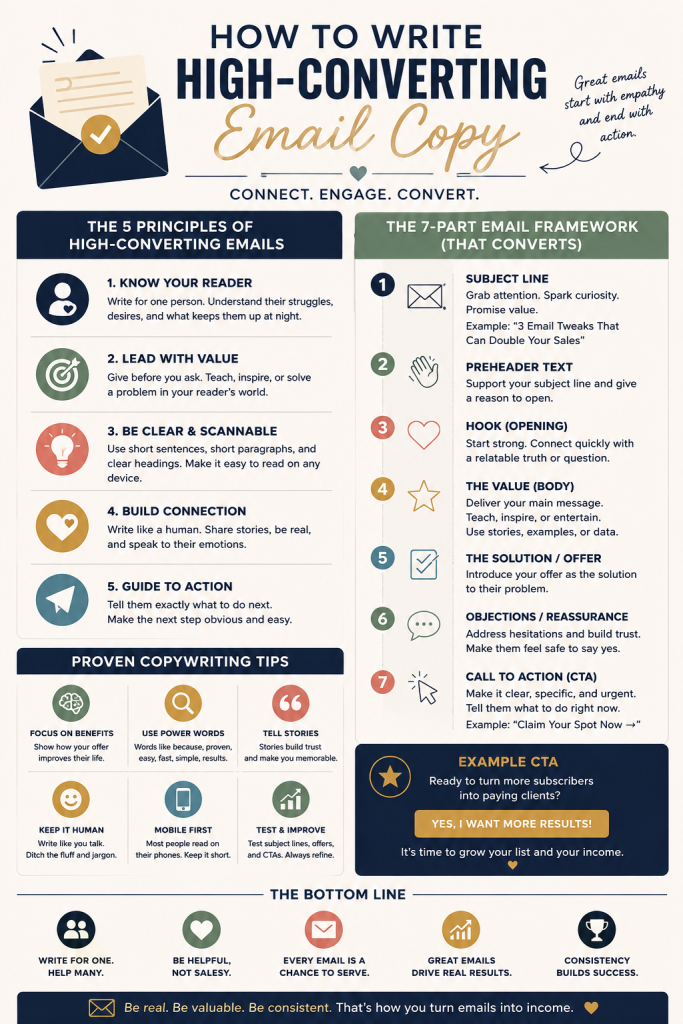
Welcome to another issue of From Inbox to Income — where we turn thoughtful emails into revenue-generating relationships, share smarter strategies (minus the sleaze), and help solopreneurs sell like trusted advisors instead of digital street magicians ✨📬
Know someone who writes emails that sound like they were generated by a caffeinated CRM? Forward this to them.
In today’s issue:
● Why “high-converting” copy is usually misunderstood
● The 4-part framework behind emails people actually read
● A simple rewrite that turns meh copy into money copy
How to Write High-Converting Email Copy (Without Sounding Like a Used Car Salesman)
Let me tell you about a tragic little email.
It began like this:
“Don’t miss this amazing opportunity!!! Limited time only!!!”
Three exclamation marks.
Zero trust.
The digital equivalent of someone grabbing your sleeve at the mall kiosk.
And yet…
This is still how many solopreneurs think conversion works.
Louder.
Pushier.
More urgency.
More “BUY NOW BEFORE THE CLOCK EXPLODES.”
But here’s the uncomfortable truth:
High-converting email copy isn’t about pressure. It’s about precision.
Because people rarely buy when they feel cornered.
They buy when they feel understood.
That distinction changes everything.
The Real Job of Email Copy
Most people think email copy exists to sell.
Not quite.
Email copy exists to move someone psychologically from one belief state to another.
That’s the real game.
From:
- “I don’t need this” → “Wait… maybe I do.”
- “This sounds interesting” → “This feels relevant.”
- “I should think about it” → “I’m in.”
Sales happen after belief shifts.
Not before.
If your copy isn’t converting, it usually isn’t because your writing is bad.
It’s because your message skipped the emotional bridge.
The 4-Part Conversion Framework
Here’s the framework I teach when someone says:
“My emails get opens… but not clicks.”
1. Start With the Friction (Not the Feature)
Weak copy says:
“My program includes 6 modules, templates, and bonus trainings.”
Cool.
But nobody wakes up craving modules.
People wake up craving relief.
Better:
“You know that weird moment when you’re staring at your email draft for 47 minutes trying not to sound salesy… so you close your laptop and promise to ‘come back later’?”
Now we’re somewhere.
Because friction creates recognition.
Recognition creates attention.
Attention creates openness.
Your reader should feel:
“Oh no. This is about me.”
That’s when the email begins.
2. Agitate the Cost of Inaction (Gently)
Not manipulation.
Clarity.
There’s a difference.
Bad copy creates fake urgency:
“ONLY 3 HOURS LEFT TO CHANGE YOUR LIFE.”
Good copy reveals natural consequences:
“Every week you avoid emailing your list, you’re not just delaying a campaign—you’re training your audience to forget you exist.”
That lands differently.
Because it’s honest.
Conversion often happens when readers clearly see the cost of staying where they are.
Not because you yelled louder.
3. Present the Shift, Not Just the Offer
Features explain.
Transformation converts.
Instead of:
“This course includes subject line templates.”
Try:
“Instead of guessing what to say every Tuesday morning, you’ll have proven prompts that help you write faster—and sound more like yourself.”
Same offer.
Different emotional impact.
People don’t buy the thing.
They buy the future version of themselves with the thing.
Always write toward identity transformation.
4. Make the Next Step Feel Ridiculously Easy
This is where many smart emails collapse.
They build interest beautifully…
Then end with:
“Click here to learn more.”
Which has the charisma of dry toast.
Instead:
- Tell them exactly what happens next
- Reduce uncertainty
- Lower friction
Example:
“Click here to see the framework. It’ll take 3 minutes, and by the end, you’ll know whether this fits your business.”
That feels safer.
Specificity converts.
Ambiguity leaks revenue.
A Before-and-After Rewrite
Let’s perform minor surgery.
BEFORE:
Hi friend!
I’m so excited to announce my email marketing masterclass! In this training, you’ll learn list building, subject lines, automation, segmentation, and more! Spots are limited so sign up now!
Technically fine.
Emotionally beige.
AFTER:
If writing marketing emails makes you feel like you’re trying to flirt in a language you barely speak… this is for you.
Because email isn’t hard because you lack strategy.
It’s hard because most advice teaches tactics without teaching trust.
That’s exactly why I built this masterclass.
Inside, I’ll show you how to write emails people actually want to open, read, and click—without becoming the internet’s most exhausting salesperson.
Take a look here.
Same offer.
Massively different conversion potential.
Why?
Because the second version leads with empathy, tension, and transformation.
Not inventory.
The Secret Most People Miss
Here’s the part nobody says loudly enough:
Conversion copy is emotional architecture.
You are not stacking sentences.
You are guiding decisions.
Every paragraph should answer an unspoken reader question:
- Why should I care?
- Is this for me?
- Can I trust you?
- Will this actually help?
- What happens next?
When your copy answers those naturally…
Sales feel less like persuasion.
And more like alignment.
Which, frankly, is a much nicer way to run a business.
This Week’s Tiny Challenge
Before sending your next email, audit it with this checklist:
✅ Did I lead with a problem the reader actually feels?
✅ Did I make the stakes clear?
✅ Did I describe transformation instead of features?
✅ Did I make the CTA specific and low-friction?
If not?
That’s your rewrite map.
Not your sign to panic.
Final Thought
The best converting emails don’t sound like copywriting.
They sound like someone who deeply understands the person reading.
That’s the craft.
That’s the edge.
And honestly?
That’s what makes email still magical.
Until next time—
Write like a human.
Convert like a strategist.